Siemens Motors announced the first public flight of their SP260D motor in an Extra 330LE aerobatic aircraft – although the motor had made its maiden, but not so public, flight on June 24. Putting out 260 kilowatts (348.5 horsepower) in near silence according to Siemens, the motor will certainly be capable of putting the Extra through its paces.
The motor weighs only 50 kilograms (110 pounds), and with its Siemens inverter adds little weight to the nose of the Extra. Pipistrel-designed battery packs grouped behind it push the power-pack weight toward the center of gravity, which should enhance handling qualities.
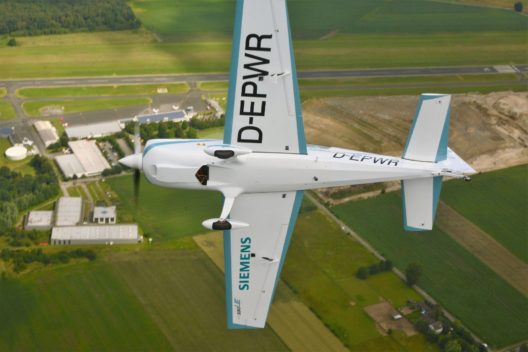
A high power-to-weight ratio is welcome in aerobatics. Note lack of exhaust pipes, oil stains on bellow of Extra 330 LE
As Electronics Weekly reports, “Support structures have been on a finite element analysis diet. The aluminum ‘end shield’, for example, which supports the motor end bearing and takes all the propeller forces, went from 10.5 (23.1 pounds) to 4.9kg 10.8 pounds) .” This presentation shows the process on page 12.
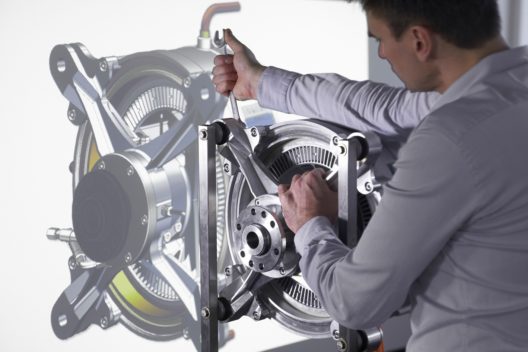
Bearing went on a digital diet, trimming several pounds from unit that keeps propeller on during stressful maneuvers
A finite element analysis program, NX Nastran, removed bits that were “barely subject to stress and therefore dispensable,” according to Siemens. The resulting structure met safety, stiffness and stability requirements. A subsequent iteration is said to have further reduced the part’s weight to 4.1 kilograms, and a prototype carbon-fiber end shield weighs just 2.3 kilograms (5.06 pounds). Considering the pounding such a bearing takes in aerobatic maneuvers, this is a real breakthrough. Parenthetically, your editor saw a propeller snap the end from a Lycoming engine’s crankshaft after the Pitts Special to which it was attached attempted a series of Lomcevaks.
Next47
Siemens has announced a new endeavor, Next47, an expansion into new technology that will take the company to its 200th anniversary in 2047. Having powered the first electric aerial vehicle, the Tissandier Brothers aerostat of 1883, Siemens says it is working in five areas that will help define its future: decentralized electrification, artificial intelligence, autonomous machines, connected (e) mobility, and blockchain applications – a digital log of transactions between business partners.
Projects like the SP260D will be one of several motor and airframe combinations that will be part of the E-Mobility program, with many more to follow. The possibilities seem boundless.