Following rigorous evaluations of all aircraft to ensure they meet all standards for the contest, Dr. Brien Seeley, President of the CAFE Foundation, announced the 13 entrants who will compete in the Green Flight Challenge at Santa Rosa, California between July 11 and 17, 2011. This exciting event will offer the public a first view of some incredible designs and resourceful competitors. Since the minimum performance required for consideration includes things such as the ability to fly a 200 mile course at 100 mph or better average speed, the ability to clear a 50-foot barrier on a 2,000 foot runway during both takeoff and landing, and the efficiency to attain at least 200 passenger miles per gallon during the overall flight, all aircraft are obviously the most efficient aerial creations yet seen. Rules were established to encourage designers to make “real world”, practical craft rather than specialized designs that could win the contest but find no real purpose or willing owners. Even things such as cockpit design and visibility play a part in the designs, with every effort to bring designs to the aviation public that will meet with broad acceptance. This can be a seminal moment in aviation, helping usher in a new era of environmentally sound, but exciting, high-performance , truly modern airplanes.
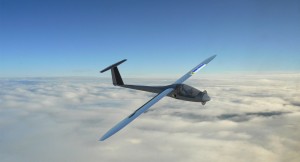
Embry-Riddle Green Eagle, a modified Stemme S-10 propelled by fuel cells and batteries
Entrants include seemingly every possible type of powerplant, an amazing array of configurations, and some obviously inspired design.
1. Einar Enevoldson, team lead for the PC Aero entry will field the Elektra 1, a single-seater from Calin Gologan’s design team. With 21 kilowatts and a span of 27.6 feet, the aircraft will fly on electric power.
2. Gene Sheehan and the Fueling Green Flight Challenger team will fly an electric airplane that looks a lot like a Quickie. Its 16 kW electric motor will propel the 16.7 foot span, single-seat craft around the course.
3. Gregory Cole, head of Windward Performance in Oregon has entered the two-seat Goshawk, a 51-foot motorglider-like airplane flying on either avgas or electric power.
4. Lawrence Speer will field the Greenelis PXLD, a tw0-seat diesel-fueled, 30 kW airplane of 35.5 foot span.
5. Mike Stude of Kansas will fly Wings of Salvacion, a single-seat, 32 kW, 16.7 wingspan, ethanol-fueled entry.
6. Richard Anderson will bring Embry-Riddle Aeronautical University’s entry from Florida – the EcoEagle, a hybrid-powered two-seat craft with a 75-foot wingspan. hybrid.
7. John W. McGinnis of Montana will fly Synergy, a six-seat craft with 32-foot wing and 142 kW bio-diesel powerplant.
8. Greg Stevenson, GSE-Aerochia’s Econo-Cruiser 3000 has two seats in tandem, a 48.3 foot wing, and a 15 kW bio-fuel-hybrid power system.
9. Ira Munn’s IKE Aerospace entry, SERAPH, is a single-seat, 30 kW, 15-foot biodiesel-hybrid.
10. Eric Raymond will bring e-Genius, an electrical aircraft with two seats, 60 kW, and a 55.4-foot wing.
11. Jim Lee of Phoenix Air (Florida) will fly a 44 kW, 47.3 span, electric tw0-seater.
12. Scott Sanford will bring the Yuneec E 1000, a three-seat, 120 kW electric airplane with 56-foot wingspan.
13. Jack Langelaan will show the Pipistrel-Penn State University entry, a Taurus G4, a four-seat, 69.1-foot span craft with 145 kW of electric power.
Dr. Larry Ford, Vice President of the CAFE Foundation, will present an overview of the aircraft at the fifth annual Electric Aircraft Symposium to be held in Santa Rosa, California on April 29 and 30, 2011. Be sure to attend to be part of the new wave in flight.