Siemen’s recently-announced 260 kilowatt (348.5 horsepower) motor has brought several comments, one from a skeptical blog reader who asked some interesting questions.
“VO” or “Volker” comments on Siemen’s claims for the motor, and throws in speculation as to the company’s veracity. (Note to readers who submit comments: please don’t attribute conclusions not intended by the editor, as in the last sentence of VO’s comment, and avoid speculating on the honorable intentions of those who announce new concepts or projects.)
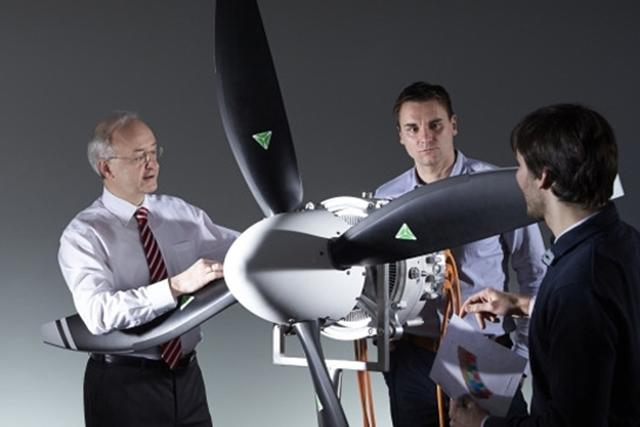
Dr. Frank Anton and associates examine 50 kilogram, 260 kilowatt motor. Streamlining the installation should be easy and elegant
“The first three you mention are kind of concepts but with reasonable or high efficiency. What is the efficiency of the Siemens motor? And whose tech are they using? They have been circling the makers you mentioned for years. Did they license something or steal again? On most you mention, I could find efficiency numbers (Emrax with a whopping 98%?) and more or less detailed specs. I don’t know. Looks like a marketing ploy.
“Typically, you would see boasting with efficiency in an aircraft app. Also which tech is it? AC induction, Sync PM, is it axial flux or not?
“As you pointed out, it does not seem to be a release of accurate info, so claiming world records is a bit irresponsible.”
VO is correct in thinking Siemens might employ a “marketing ploy.” Your editor wrote technical white papers, sequences of operations, operations manuals and other detailed, dry bits of prose, but also turned out many proposals, marketing brochures, and scripts that called for a more poetic temperament. That doesn’t make the former more correct than the latter – just different in approach and selected audience.
In a March 24 press release, Siemens explains that their earlier efforts with an electric hybrid drive in 2011, “optimized” in 2013, had a power/weight ratio of “around 5 kilowatts per kilogram, which at that time was unsurpassed, but it only delivered a relatively modest 60 kilowatts of continuous power — enough for a single-engine light aircraft at most.”
Part of the weight reduction that allowed Siemens to make its power/weight ratio claim for its 260 kW unit was “optimizing” the motor’s end shield, cutting the weight from 10.5 kilograms to 4.9 kilograms. (Your editor’s manager discouraged the use of “optimized” numbers since that implied that one couldn’t do better. Since statements made in press releases and advertising copy can be interpreted as legal contracts with a potential client, such hyperbole is reined in by many tech editors.)
This aluminum component “supports the motor bearing and the propeller, which is fixed to a continuous drive shaft without a gearbox in between.” Dr. Frank Anton, head of electric motor development at Siemens, explains, “It’s subject to very large forces whenever the nose of the aircraft moves up or down, so it’s an absolutely vital component for the safety of the aircraft. That’s why, in the past, it was always pretty solid and therefore correspondingly heavy.”
Using the Siemens computer aided engineering (CAE) program NX Nastran, engineers performed a finite element analysis on the end shield, identified the elements that are barely subject to stress and are therefore dispensable. Dr. Anton explains, “Nature designs our bones in a similar manner. Their structure follows the lines of stress from external forces. Using this iterative process, we end up with a solution an engineer would never have been able to work out by means of theory.”
Departing from the aluminum filigree structure that they crafted, Siemens’ researchers are now working with a carbon-fiber reinforced polymers end shield “that weighs a mere 2.3 kilograms, less than a quarter of the conventional component.”
Siemens engineers took on the electromagnetic design of the motor, using a cobalt-iron alloy in the stator for high magnetizability. They arranged permanent magnets in the rotor in a Halbach array, with four magnets “positioned next to one another in such a way that the orientation of each field is in a different direction.” Magnetic flux can reach high levels with a minimum use of materials. This might help them attain the 97-percent efficiency goal they note in their press release.

Difference between Halbach and more conventional arrangement of magnetic flux
Cooling uses “direct-cooled conductors” and “an electrically non-conductive cooling liquid.” Siemens uses silicon oil or Galden. The Solvay Plastics web site explains, “Galden® PFPE is a line of high-performance, inert, fluorinated fluids used as heat transfer and for various high-tech applications in the Electrical & Electronics and Semiconductors markets.”
The Halbach array is not a new idea, and is in use in LaunchPoint motors. The fact that two different companies have developed motors using this technology is not an indicator of skullduggery on either’s part – no more so than that they both use electricity to power the motor.
Dr. Anton will be at the ninth annual Electric Aircraft Symposium in Santa Rosa, California on May 1st and 2nd, along with Michael Ricci of LaunchPoint Technologies. Attendees will be able to compare the two company’s approaches, a benefit of an open forum and an exciting opportunity to hear about the latest in technological breakthroughs in motors. (Now, that approaches hyperbole – but one within legitimate bounds.)
Doubtless, Dr. Anton will expand on this idea: “Only a very few companies have such detailed understanding of converters and motors, not to mention decades of experience working with them in very different and sometimes very extreme environments. What’s more, at Siemens we’re committed to the idea of electrically powered flight and have the staying power to develop the new drives.”
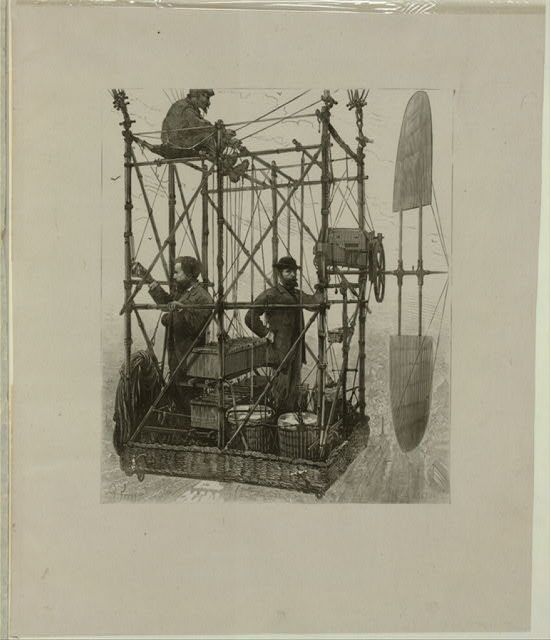
First in electric flight: Tissandier Brothers fly their Siemens motor-powered aerostat in 1883
History is on his side in the matter of decades of experience. The Tissandier brothers used a Siemens motor on their electrically-powered aerostat in 1883, a world first.